
Microsoft saw its shares fall 2.6% on Monday.

India's top private banks might soon exit from the gold coin business.

'The market has picked up for commercial vehicles. We are very close to pre-pandemic levels.'

Getting locked into instruments before the new regime kicks in would be a good strategy.

The government's step could push investors to choose riskier equity, or to fall back on bank deposits, thereby negatively impacting the debt market which actually needs to grow, points out T N Ninan.

Fintechs need to behave with responsibility and transparency. A lot of mis-selling has been happening. Other issues have been plaguing the fledgling industry -- high interest rates, even higher processing fees, harsh collection process and, most critically, data leakage leading to rampant frauds, points out Tamal Bandyopadhyay.

Anup Roy and Krishna Kant on the challenges the public sector banks face in revitalising themselves
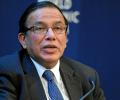
The account turned bad before Chaudhari took over as SBI chairman and the asset was sold to AARC following an open bidding process, months after Chaudhari retired, explains Tamal Bandyopadhyay.

A RBI constituted panel on financial inclusion headed by Nachiket Mor had recommended the setting up of the payments banks in order to deepen access to finance.

Players such as Kidaara, True North, and Multiples Alternate Asset Management move outside the confines of just being a family-style financial office and become a true PE heavyweight.

Let all the stakeholders, especially the government, remember that if the Make in India lion needs to roar and rise again, it won't happen unless India Inc rises too, points out Shekaar Subramanian.

In FY23, the State Bank of India (SBI) reported a 57.4 per cent jump in its net profit to Rs 55,684.17 crore. But the chairman of the country's largest bank, Dinesh Khara's annual pay for this creditable performance was just Rs 37 lakh (his peers at state-run banks are no better off). Look at his private bank rivals - most pocketed in excess of Rs 7 crore annually - plus stock options.

Fintech companies believe that the impact of Reserve Bank of India's order last week on unsecured loans will be visible in six to 12 months and prompt them to diversify and strengthen their secured portfolio. Fintechs which source funds through banks or non-banking finance companies (NBFCs) are looking at quickly building their secured portfolio options to at least 40 per cent of their total portfolio. "Over the medium to long term, as part of our product strategy, we are evaluating secured products which can be enabled over a digital platform" said Yogi Sadana, the founder of Zype, a lending-focussed fintech.

Bandhan Financial Services, which was given a banking licence on Wednesday, hopes to come up with a unique business model, with a mix of doorstep and retail banking.

European Investment Bank to set up office in India.

Ramalingam Kalirajan explains the pros and cons of both investment types.

Policymakers should aspire to restore the pre-Independence environment where the rupee was trusted and used all over South Asia, in Southeast Asia, in West Asia, and in East Africa, suggests Ajay Shah.

The corporate sector does not care from where the money is coming.

Fundraising activity in the debt market is gaining momentum ahead of the festival season. Several non-banking financial companies (NBFCs) and the National Bank for Agriculture and Rural Development (Nabard) are planning to raise at least Rs 5,560 crore in the next two days by issuing bonds, with a greenshoe size of Rs 6,370 crore. Ajay Malglunia, managing director and head of investment grade group at JM Financial, said, "The market likes certainty, the market will gain clarity after the US Federal Reserve's (Fed's) policy.
'Public sector banks are like an extended arm of the government.' 'They rush to rescue certain sectors or they rush to invest in certain sectors to prop up the economy which the private banks don't.'

The move will have cascading effects for lot of related sectors

Could it have been more reformist? Of course, but this is an election year Budget, observes Akash Prakash.

'It may sound like sacrilege, but does it really matter if the global raters downgrade India for fiscal slippage?' asks Tamal Bandyopadhyay.

Non-performing assets of banks have been on the rise for past several months due to slowdown in the economy.
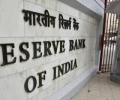
Focus to be on unbanked areas; initial capital is set at Rs 100 crore; India Post can apply.

Business is down to such an extent that last year these firms could not even meet RBI's capital norm of Rs 50 million for partnerships and Rs 100 million for public and private firms in this line of business.
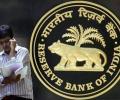
Historically, the RBI has tried to keep the crooks at bay by issuing a circular a day. What it needs is more onsite supervision. Merely checking high-frequency data with the help of technology is insufficient, notes Tamal Bandyopadhyay.

'Banks, fund managers, NBFCs, rating agencies, those buying into debt funds -- all of them will have to watch their step as India's financial system enters a new phase,' warns T N Ninan.

A vast majority of borrowers are in the essential services' supply chain with tiny and micro businesses, and this has sprung back.

The currency market won't care for our moans, groans, cries and sighs. The rupee will find its own level, explains Tamal Bandyopadhyay.

Invest 5 to 10 per cent in a banking sector fund. Ensure that mutual fund's portfolio includes all three players -- private sector banks, public sector banks and NBFCs.

Tamal Bandyopadhyay offers some unsolicited advice for a government wh,ich came to power, with brute majority and the nation's pragmatic chief money man.

Analysts on Wednesday welcomed the Reserve Bank's decision to grant bank licences to Bandhan and IDFC, but expressed dismay that only two of the over two dozen aspirants made the cut.
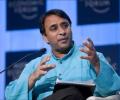
In 2012, Akula quit as chairman of Bharat Financial Inclusion (formerly SKS Microfinance), which he'd founded and led to a successful initial public offering

Ahead of the Budget, the government has achieved almost half the divestment target of Rs 65,000 crore. FY23 divestment receipts are unlikely to be anywhere close to the budgeted target.

While weather forecasters remain divided on how the monsoons will play out in India over the next few months, analysts believe the news at the current juncture - at best - can trigger a knee-jerk reaction in the markets. They believe it is too early to say whether the sub-par monsoon on account of El Nino can seriously dent the market sentiment in the short-to-medium term. "These are just initial forecasts and we will have another round / status update from the weather forecasters a month down the line.

Prime Minister Narendra Modi on Saturday announced the adoption of the New Delhi Leaders Declaration, a significant victory for India's G20 presidency that came amid increasing tensions and divergent views over the Ukraine conflict.

The 30-share Sensex gained 271 points to end at 28,805 and the 50-share Nifty ended up 84 points at 8,712.

Bringing in the untapped informal sector into the formal one will benefit business.

Industry players believe the new DFI model will be initially risk capital, which will then be used to mobilise additional resources from development agencies such as World Bank.
